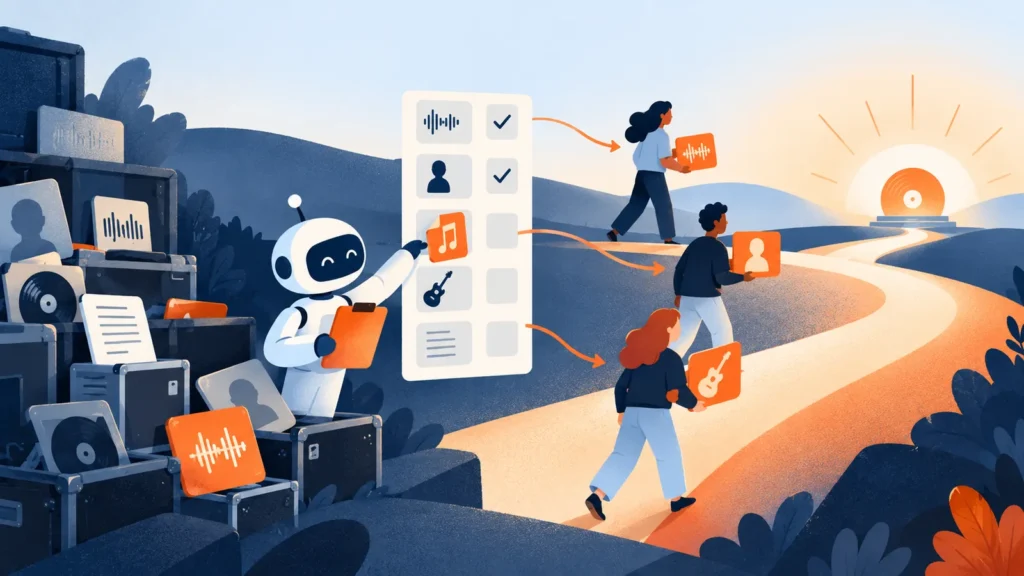
Coordinate Creative Assets, Release Operations and Campaign teams in Dots or Claude Duet. Handle late changes and restarts, and leave every release decision with the artist.
What you will be able to do
- Give each team its own lane: Set up three agent teams: Creative Assets, Release Operations and Campaign. Each one gets at least two named roles, its own job and a named recipient for its work. All three work from one shared release record that shows who wrote, who played, who consented to what and who called the take.
- Put a check on every handoff: Build a handoff table that lists the sender, the receiver, what passes between them, the acceptance check, who accepts it and what happens if it fails. Write checks for the audio version manifest, the credits and rights review (CSV) and the campaign sequence (ICS). No team approves its own release decision, and Campaign writes only from facts the other two teams have accepted.
- Run the Factory in Dots or Claude Duet: Connect your chosen agent only to the files and apps the sample packet needs. Write instructions that tell it to follow the approved record. Then run the packet through the handoffs with the waiting periods shortened. Each run returns a current release record, the drafts the change affected and the artist or rights decisions that are still open.
- Handle a late change without damage: A revised master and a release date moved by a week arrive in the same hour. Every team stops. The replaced master stays on record, and any draft carrying the old date is pulled. No team starts again until all three share the same facts.
- Test, tighten and judge for reuse: Test the Factory with duplicate files, changed files, conflicting credits, blocked work and a run cut off partway through. Trace each failure back to a missing boundary, retry limit or escalation owner, and fix the instructions. Then run a second batch and judge whether the process can be used for your next release.
- Record the release decision: The artist and the release owner mark every open item approved, returned or stopped, with a reason and an owner. They name the one person allowed to deliver. The result is a record another operator can read without asking anyone.
Taught at learn.c-o-u-r-s-e-s.com: lessons that adapt to your level, an AI tutor you can ask anything, quizzes and flashcards, and a certificate when you finish.