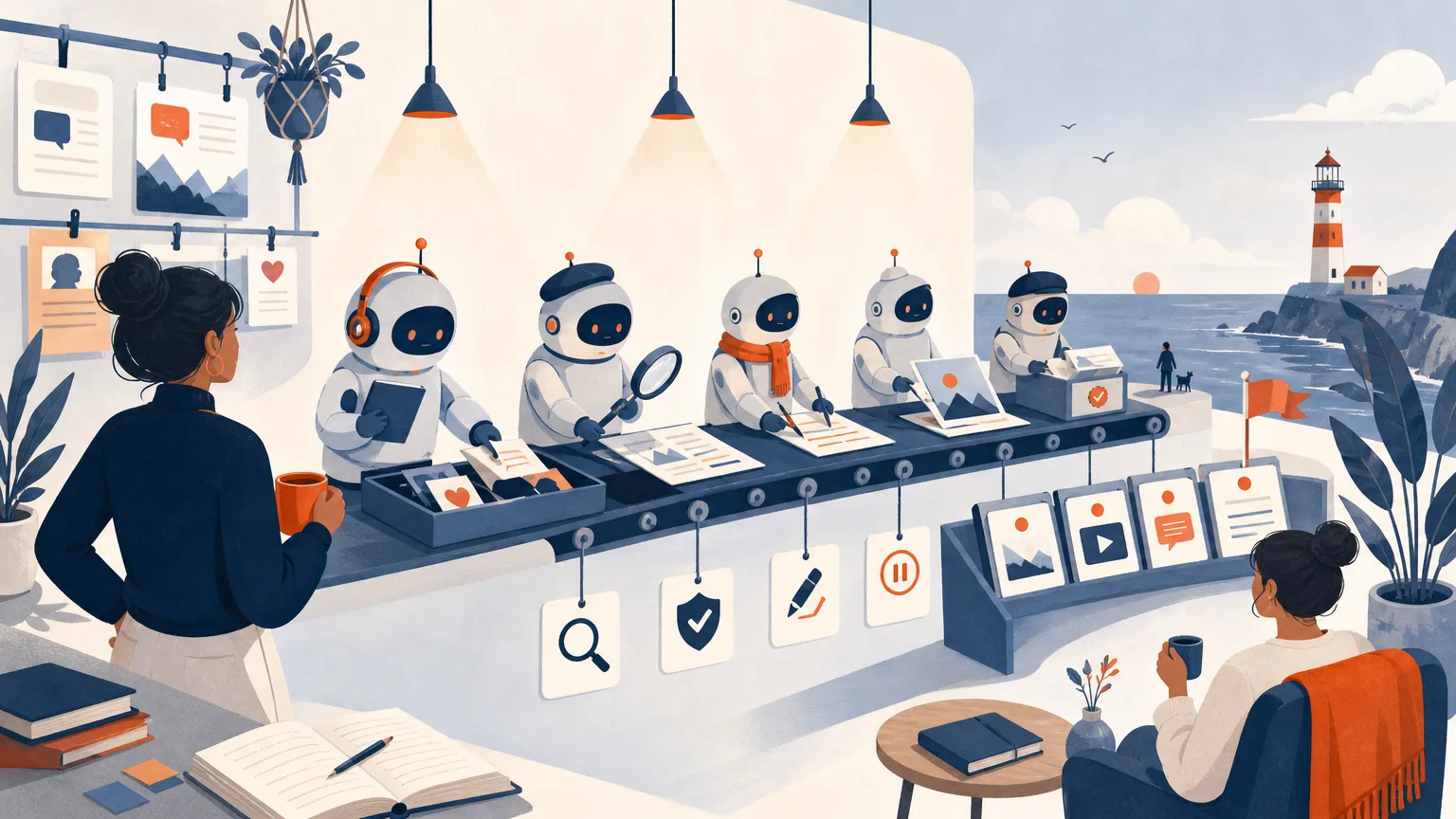
Build and supervise agents in OpenAI Dots or Claude Duet that keep your idea queue, research, scripts and edit prep moving between reviews. Nothing is released until you approve it.
What you will be able to do
- Define an agent role you can supervise: Turn a recurring prompt into a standing goal for a named role such as Editorial Desk. Give it a scope, approved sources and connections, an agreed report, a human owner and a rule for stopping, pausing or retiring it. Then decide whether it should be a single run or a continuing brief.
- Keep an idea queue sorted by what viewers need: Run a scheduled intake agent that groups audience questions by viewer need. It merges duplicates and attaches your earlier answer, and it flags stale ideas. It never ranks by provocative wording or predicted reach, and it collects no personal data the answer doesn't need.
- Get research packets that hold up when a source changes: Direct a research agent to build claim-to-source packets with links, dates and the exact statement each source supports. When a newer source contradicts an older one, the agent stops the scripts that depend on it and brings the conflict to you.
- Get script drafts that still sound like you: Supervise a scripting agent that drafts a small batch from your voice guide and your accepted packets. Your corrections go into its standing instructions, so accepted passages stay as they are. Conflicting notes come back to you instead of being averaged.
- Keep edits, captions and adaptations tied to the script: Coordinate CapCut edits, SRT captions and permitted Higgsfield assets through a production agent. It keeps a versioned edit queue, marks the export steps you do by hand, and checks that no adaptation drops a qualifier or changes a fact.
- Approve a release queue and read the results honestly: Put together an approval packet with scripts, sources, exports, disclosures and open permissions. Mark each piece ready, returned or held, and record who may publish it. Then read a small performance report, keeping results apart from hypotheses, and plan the next run as a small test.
Taught at learn.c-o-u-r-s-e-s.com: lessons that adapt to your level, an AI tutor you can ask anything, quizzes and flashcards, and a certificate when you finish.


