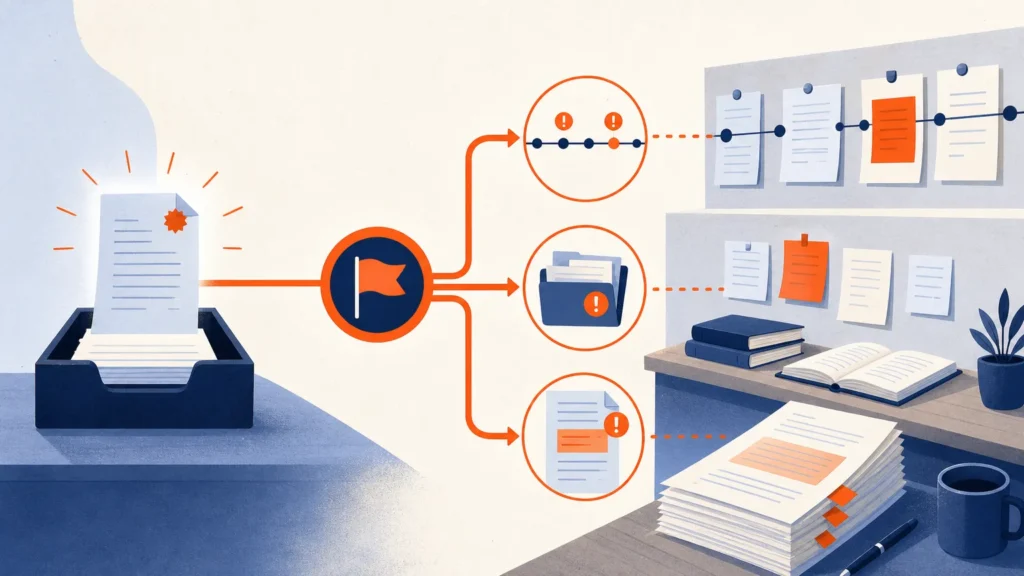
Build a Factory of three agent teams on a sample matter. Then test it with handoffs, late evidence, blocked work and a restart. Nothing is released until the attorney approves it.
What you will be able to do
- Give every agent a defined job on a defined team: You'll assign intake, chronology and evidence agents to a Matter Intelligence team, research, drafting and synthesis agents to a Work Product team, and source-checking and release-checking agents to a Review team. Each agent gets its inputs, outputs and stop rules. You'll find the places where two agents could change the same output, and you'll make sure no agent can expand its own access or release authority.
- Build a shared matter record that handoffs pass through: You'll set out the record's sections, each team's read and write rights, an approved source snapshot, a shared assignment ID, and the fields every entry must carry. You'll also write the acceptance criteria that work has to meet before it moves to the next team, and decide what may be shared with outside counsel and on what terms.
- Have Dots or Claude Duet report back, and check what it says: You'll pick OpenAI Dots or Claude Duet to follow the approved record across team handoffs. It reports source-linked changes, draft status and unresolved evidence questions. You'll check that account against the record and flag any statement the record doesn't support.
- Make a late correction reach every affected deliverable: You'll trace a seeded contradiction or a late piece of evidence back to its sources and pause the work it affects. Then you'll ask the attorney to resolve it, and confirm the correction reaches the chronology, research notes and draft, not just one document. You'll keep allegations from becoming facts, and stop a newer document from quietly outranking a better-supported one.
- Test the Factory under pressure: You'll run the Factory with changing inputs, withheld sources, changed permissions, blocked work and an interrupted run that restarts later. You'll check for duplicate work, check that it resumes from the last accepted step without losing the reason for each change, and check that every exception has an owner.
- Set attorney gates and write down the limits: You'll set approval gates for sources, conflicting evidence and release, and keep a gate record of what was reviewed, the decision, who made it and when. Rejected work goes back to its owner with reasons. To finish, you'll write a limitations register: what the Factory hasn't been shown to handle, and what needs more evaluation before anyone considers it for a real matter.
Taught at learn.c-o-u-r-s-e-s.com: lessons that adapt to your level, an AI tutor you can ask anything, quizzes and flashcards, and a certificate when you finish.